I-10 Loop 202 to State Route 387 Wild Horse Pass Corridor

WATCH FOR overnight LANE RESTRICTIONS ON EASTBOUND & westbound I-10
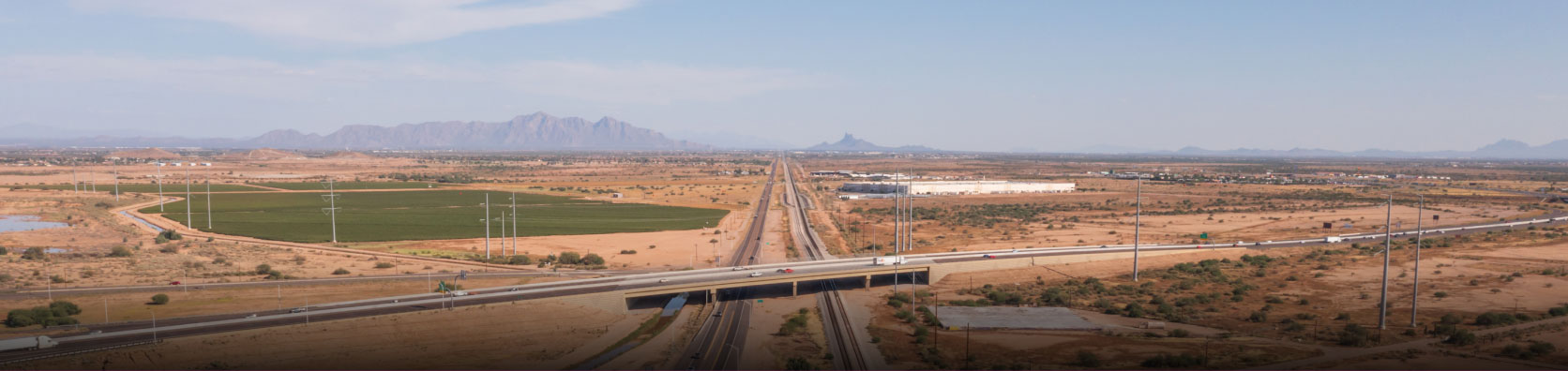
Construction on the I-10 Bridges Over the Gila River Project began in mid-2024 and will be the first project segment that will reach substantial completion. The finishing touches to the new eastbound and westbound bridges are being added, with the project scheduled to wrap up in November. The I-10 Gas Line Road to South of State Route 387 Project started earlier this year with crews making considerable progress with pavement of the new third lane on eastbound I-10 underway. Finally, the I-10 Gila River Indian Community Project started preliminary construction work set up operations in October.
After two and a half years of active construction, the I-10 Bridges Over the Gila River Project is on pace to reach substantial completion in November. The project is completing median barrier work that includes painting, installation of signs and final lane striping. The new eastbound and westbound I-10 bridges over the Gila River are now three lanes and are about 6 feet higher than the previous bridges. The previous two-lane bridges were removed. In total, earthwork operations involved 14,014 cubic yards of roadway excavation, 8,295 feet of drilled shaft work, the application of 29,000 tons of asphaltic concrete, and the pouring of approximately 9,000 cubic yards of concrete.
Construction crews have begun work on the substructure for the new bridge at SR 387. This work consists of drilling shifts and constructing columns and pier caps. Crews have also constructed Mechanically Stabilized Earth (MSE) walls. These walls are a type of retaining wall that uses reinforced soil to support itself and hold back steep hills or roads. At Seed Farm Road, crews have started removing the existing bridge and are constructing drilled shafts for the new bridge. Pavement work for the new third general purpose lane on a section of eastbound I-10 north of Casa Grande has also begun. This marks the first pavement work for that new third lane in the project.
Remember that the speed limit in this area is 55 mph. Signage has been placed at every mile to remind motorists to slow down when driving through the project corridor.
The project team for this segment has finalized the design and construction plans for the busiest segment of the Corridor. Now, the I-10 Gila River Indian Community Project, (located on I-10 in both directions between the Loop 202 and the Gila River) is entering the preliminary active construction phase. Initial work includes stormwater pollution prevention, plant salvage, clearing and grubbing, shoulder work along westbound I-10 south of Queen Creek Rd, grading, drainage pipe installation, and steel casing installation.
In his 35-year career as a civil engineer, Trent Kelso has managed several ADOT freeway widening and interchange improvement projects throughout Arizona. He’s led projects teams on Loop 101, I-17, US 60 and I-10 to name just a few.
Today, Trent is bringing his decades of knowledge and experience to the 26-mile long, I-10 Wild Horse Pass Corridor project, where he serves as corridor manager.
Trent began his career working on ADOT highway projects in 1990 when he moved to Arizona from the frigid Midwest. He was fortunate to learn about transportation projects from the veteran engineers on the team. He notes that when he started in the industry, plans were still hand-drafted and communication was slow, often involving fax machines and sharing sets of blue-line technical drawings across departments, agencies, and contractors.
“Today, we have incredibly sophisticated design software, real-time project information, virtual meetings, and instant communication,” Trent said.
These technology advancements help large-scale highway projects that require high levels of coordination and partnership, such as the I-10 Wild Horse Pass Corridor Project, move forward. Keeping this project on track has required years of planning, problem-solving, and teamwork to turn these improvements into reality.
“This isn’t just a freeway widening project - it involves working closely with the Gila River Indian Community, multiple agencies, utilities, consultants, contractors, and many other stakeholders.” Trent said.
Once the I-10 Wild Horse Pass Corridor project is completed, ADOT and the Gila River Indian Community will have been collaborating for 11 years to improve the Corridor. As corridor manager, Trent is now providing mentorship and guidance to junior members of the team, following the examples of the engineers he learned from early on in his career. When asked what advice he’d give to those who are starting their engineering careers, he encourages them to be curious, find mentors, take on challenges, and recognize that they may not have all the answers at first.
“Technical knowledge is essential, but learning to listen, communicate clearly, and work with people is just as important,” Trent said.
This approach has served Trent well during his career and anyone who drives on major highways throughout Arizona can see that philosophy at work in the projects he has been part of.
“I can drive around the Valley today and see a number of freeway and roadway improvements that I had a small part in delivering, and I take a lot of satisfaction in that,” Trent said. “As a project manager, every time you see a project you’ve worked on actually get constructed is a highlight.”
Trent is looking forward to the day he will drive the completed I-10 Wild Horse Pass Corridor between Phoenix and Casa Grande and see the results of everyone’s hard work.
“This is a great example of what can be accomplished when entities work together toward a common goal,” Trent said.
Pre-construction virtual public meeting recap
The project team hosted the I-10 Gila River Indian Community Project Pre-Construction Virtual Public Meeting on Aug. 5, 2026.
Project team members started the presentation with an overview of the I-10 Wild Horse Pass Corridor projects and provided a map, construction timeline, highlighted project benefits, and an overview of construction impacts. This was followed by an overview of the I-10 Gila River Indian Community Segment, the 11-mile stretch of I-10 between Loop 202 and the Gila River bridges. The project team shared the design plans for this segment’s interchanges and bridges, as well as the construction timeline, aesthetic concepts, and project funding information.
A total of 55 individuals attended the meeting and were provided time to ask questions about the project and improvements. Many of the questions were related to the design of the I-10/SR 347/Queen Creek Road interchange, which will feature a flyover ramp that connects northbound SR 347 to westbound I-10 allowing a continuous flow of traffic between the two highways.
The full public meeting presentation and recording can be viewed by clicking on the links below:
I-10 Gila River Indian Community Segment Pre-Construction Virtual Public Meeting Presentation Slides
On October 8, ADOT Community Outreach Manager/Public Information Officer Marcy McMacken hosted members of the media at Firebird Raceway and provided live interviews and live shots of the I-10 Gila River Indian Community Project. The media received an update on the entire corridor including the start of active construction on the I-10 Gila River Indian Community Project, the 11 mile project segment closest to the Phoenix/Chandler area. Marcy also provided an update on the I-10 bridges over the Gila River. This media opportunity generated media stories on local television and radio stations as well as in print media. In total, there have been 17 media stories since the project’s last quarterly newsletter in July.
The I-10 Wild Horse Pass Corridor Project and SR 347 Improvement Project public involvement teams were invited to present at the Casa Grande Rotary Club on Tuesday, Aug. 18. Members of the Rotary Club were very engaged and showed interest by asking detailed questions about the project components and timeline. The group expressed their appreciation for the improvement project and asked the teams to come back again for another update next year.
If any other clubs, organizations or agencies would like our team to present on this project, please submit a request through the project website.
To receive updates and information on the Wild Horse Pass Corridor call the project hotline at: 602.522.7777 or use the online contact form.
Schedules are subject to change based on weather and other unforeseen factors. For more information, please call the ADOT Bilingual Project Information Line at 855.712.8530 or go to azdot.gov/contact and select Projects from the drop-down menu. For real-time highway conditions statewide, visit ADOT's Traveler Information Site at www.az511.gov, Need to know where a milepost is? Click on the "Mile Markers" icon on the map at www.az511.com. Follow ADOT on Twitter (@ArizonaDOT) or call 511, except while driving.